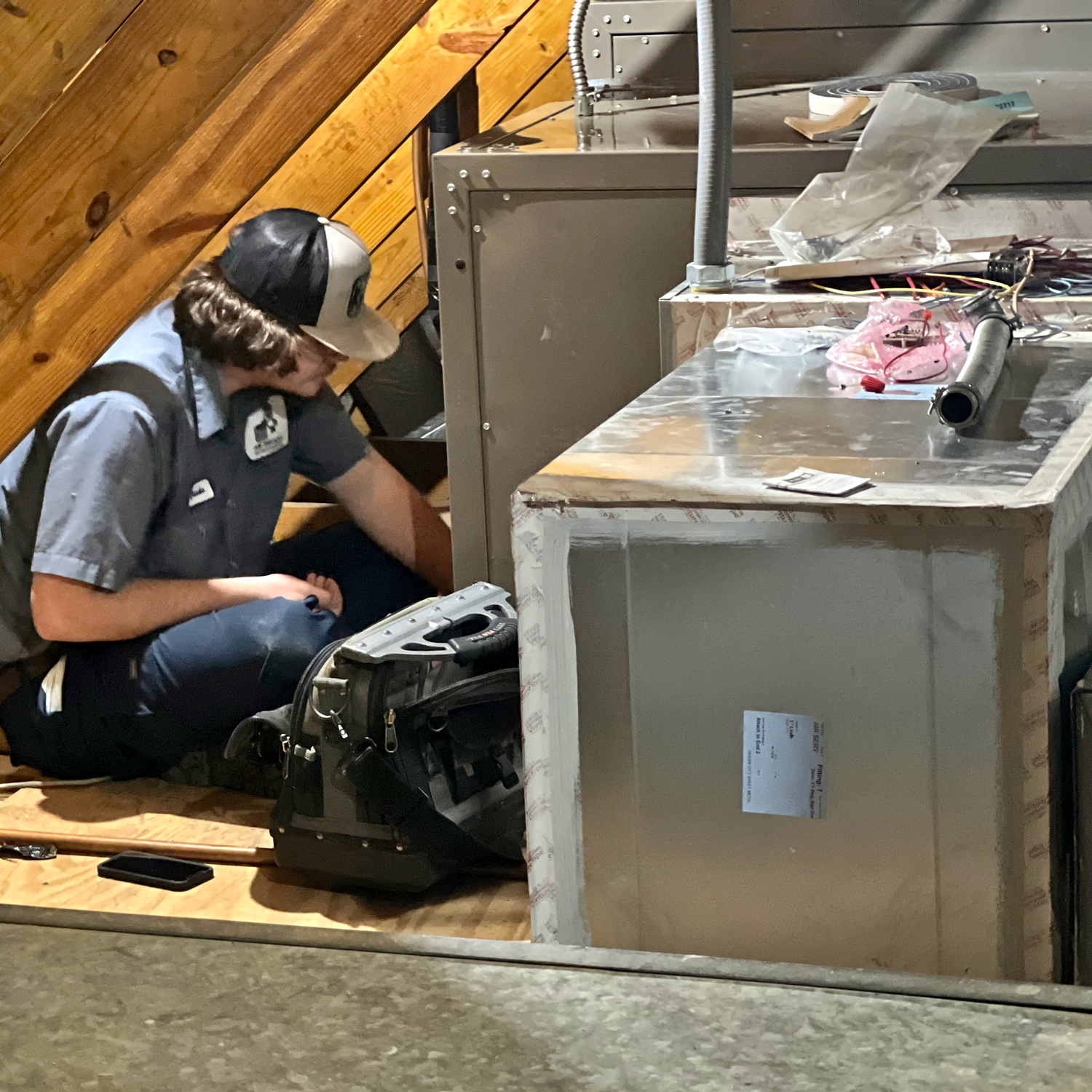
The first genuinely cold night in the Carolinas is when most heating problems announce themselves, and it’s also the night every HVAC company in the region is booked solid. Scheduling maintenance in the fall keeps you out of that queue. Here’s when to book, what we check, and what it costs.
When should you schedule heating maintenance in the Carolinas?
Book it in September or October, before the first cold snap. ENERGY STAR recommends an annual pre-season check-up, and is specific: cooling in the spring, heating in the fall, because contractors get busy once summer and winter come. NOAA’s 1991-2020 climate normals put the average first 32-degree night at Charlotte Douglas at November 3, so a September or early-October visit leaves you four to eight weeks of margin. A system that sat idle since March gets asked to work on the first cold night with no warning. Booking early means you find the worn igniter or the cracked belt on a 65 degree afternoon instead of a 28 degree morning.
If you’ve already missed the fall window, book anyway. A January tune-up is worth more than a skipped one, and we’d rather find a failing part during a scheduled visit than at 11pm on an emergency call.
What does a heating maintenance visit include?
Air Services of the Carolinas runs a 20-point heating inspection on every maintenance visit, and you get a written report on every unit we touch. Most companies describe a tune-up in general terms. Here’s the actual checklist, grouped by what each step protects. Three of those twenty points carry most of the weight: the gas train for safety, electrical connections and amp draw for reliability, and temperature rise for whether the system is actually moving the heat it makes.
| What we check | Why it matters |
|---|---|
| Inspect burners; clean pilot, igniter and thermocouple; inspect gas connections and gas valve; check gas pressure; visual inspection of flue pipe | Combustion and gas safety. A dirty burner burns unevenly and wastes fuel, and a fault anywhere in the gas train is the one category of heating problem that is a safety issue rather than a comfort issue. |
| Tighten all electrical connections; check amperage; check supply voltage; examine fan controls; inspect fan limit control; check limit control; check safeties | Loose connections and out-of-range amp draw are the most common cause of a no-heat call. They’re also the cheapest thing on this list to fix before they fail. |
| Check and replace filters; check correct temperature rise; inspect and adjust belts and pulley; examine and lube bearings; observe unit operation | Airflow and mechanical wear. Temperature rise is the number that tells us whether the system is moving the heat it produces, and it’s the check most quick tune-ups skip. |
| Examine heat elements | Electric and heat pump backup heat. Strips fail one at a time, so a system can lose a third of its backup capacity and still feel like it works until the coldest week of the year. |
| Check thermostat | Calibration and staging. A thermostat calling for the wrong stage will run up a bill that looks like an equipment problem. |
| Provide reports on all units | You get the readings in writing, so next year’s numbers mean something. |
Heat pump or gas furnace? The check isn’t the same
Most homes in our service area run heat pumps, and a heat pump pre-season check looks different from a furnace check. The U.S. Energy Information Administration’s South Carolina profile reports that 7 in 10 South Carolina households use electricity as their primary heating source, with about one in four on natural gas. The split matters, because the failure modes have almost nothing in common. A furnace fails on combustion and gas-train components. A heat pump fails on the parts that let it run in reverse, and on the backup heat that carries the house when it can’t keep up.
| Gas furnace | Heat pump |
|---|---|
| Burner condition and flame quality | Defrost cycle. If it doesn’t initiate, the outdoor coil ices over and heating capacity drops. |
| Heat exchanger inspection | Reversing valve operation, which is what switches the system from cooling to heating |
| Gas pressure and gas valve | Auxiliary heat strips, tested individually rather than as a group |
| Flue and venting | Outdoor coil clearance, since leaves and mulch pile up against it through the fall |
| Temperature rise across the heat exchanger | Temperature rise in heat pump mode, which runs lower than a furnace by design and is often mistaken for a problem |
Heat pump air feels cooler coming out of your vents than furnace air. That’s normal: a heat pump delivers heat at a lower supply temperature over a longer run time. Homeowners who switch from gas often call us that first cold week convinced something’s broken, when the system is doing exactly what it should.
How much does a heating tune-up cost in Charlotte and Rock Hill?
A one-time heating tune-up is $79 per unit, and our Seasonal Maintenance Program starts at $189 per year for your first heating and cooling system, plus $139 per year for each additional system. The plan covers the fall heating visit and the spring cooling visit. Members also skip overtime charges, get a discount on repairs, and move to the front of the line on emergency calls. That last part is where the plan usually pays for itself, because one after-hours no-heat call in January costs more than a year of coverage.
| Option | Cost | What you get |
|---|---|---|
| Seasonal Maintenance Program, first system | From $189 per year | Fall heating visit and spring cooling visit, no overtime charges, discounted repairs, 24/7 priority service |
| Each additional system | From $139 per year | Same coverage on a second or third system |
| One-time heating tune-up | $79 per unit | Single fall visit, no plan commitment |
One customer put it this way: “Most affordable option in our area! They are quick and efficient would highly recommend their service plans good value.” (Alana B., Google review, February 2026). You’ll find the $79 tune-up and our other current offers on the specials page.
What does skipping heating maintenance actually cost you?
Deferred maintenance shows up on your power bill before it shows up as a breakdown. Airflow is the usual culprit, and ENERGY STAR puts airflow problems at up to 15 percent of system efficiency. That’s a figure they cite for cooling, but it’s the same blower doing the work in both seasons. On filters they’re blunter: a dirty filter increases energy costs and can damage your equipment, leading to early failure.
The safety case is narrower but more serious, and it applies to gas equipment. A dirty burner or a cracked heat exchanger causes improper burner operation, and per ENERGY STAR either condition can make the equipment operate less safely as well as less efficiently. That is what our burner, heat exchanger and flue inspection looks for, and it is not something a homeowner can check.
We’ll also tell you when maintenance isn’t the answer. If your system is 15 years old and facing a second significant repair, we’ll walk you through the replacement math instead of selling you a tune-up on equipment near the end of its life.
Do you need maintenance or a repair?
Maintenance is preventive, and it’s the wrong call if your heat already isn’t working. If the system is blowing cold air, short cycling, tripping the breaker, or making a noise it hasn’t made before, that’s a repair visit. Our guide to the signs your heating system needs repair covers the checks worth making first, and heating repair is available 24/7. If your heat pump has visible ice on the outdoor unit, start with what’s normal and what isn’t when a heat pump freezes up.
Where we serve
Air Services of the Carolinas serves the Charlotte and Rock Hill region from our office in Clover, South Carolina. In South Carolina: Clover, York, Fort Mill, Indian Land, Lake Wylie, Newport, Rock Hill and Tega Cay. In North Carolina: Ballantyne, Belmont, Bessemer City, Charlotte, Concord, Denver, Gastonia, Indian Trail, Kings Mountain, Pineville, Stanley, Steele Creek and Weddington. We’re family owned and operated, and our technicians are NATE certified.
Frequently asked questions
How often should a heating system be serviced?
Once a year, in the fall. ENERGY STAR recommends annual pre-season check-ups for heating equipment. If you have a heat pump, it runs for both heating and cooling, which is why it gets two visits a year rather than one.
How do I know if my furnace needs cleaning?
The common signs are a burning or dusty smell in the first week of use, uneven heating between rooms, longer run times to hit the same thermostat setting, and a yellow rather than blue flame on a gas burner. A yellow or flickering flame is the one worth acting on quickly, because it points to incomplete combustion.
What can I do myself between tune-ups?
Change or clean the filter every month through heating season, which is the maintenance task ENERGY STAR lists under actions to do yourself. Keep supply and return vents clear of furniture and rugs, and keep leaves and mulch away from the outdoor unit if you have a heat pump. Leave anything involving gas, refrigerant or wiring to a technician.
Does a brand new heating system still need annual maintenance?
Yes, and the warranty is usually the reason. Most manufacturers require proof of annual professional maintenance for coverage to stay in force, so skipping a year on a new system can cost you the coverage on its most expensive components. New equipment also needs its first-season airflow and temperature rise readings recorded, which gives you a baseline to compare against later.
Book your fall heating tune-up
Get on the schedule before the first cold night. Call Air Services of the Carolinas at (704) 309-6088 in North Carolina or (803) 628-2561 in South Carolina, or request service online. Ask about the Seasonal Maintenance Program if you’d rather cover both seasonal visits in one plan.
